2026-09-17
Fused SwiGLU: Tied on Speed, Two Tensors Instead of Four
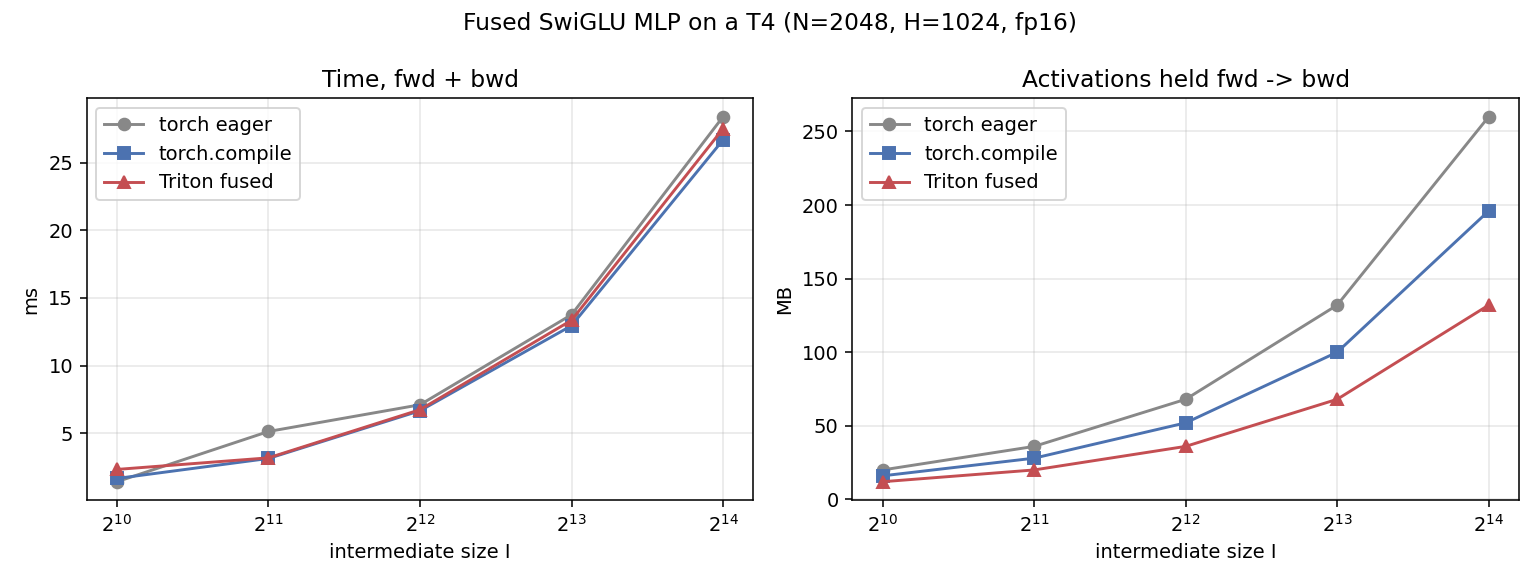
9th kernel: a fused SwiGLU MLP, the last piece of a transformer block I hadn't written. A SwiGLU MLP makes three [rows, intermediate] tensors — g and u from two projections, then h = silu(g) * u — and since intermediate is 3-4x hidden, that is where the block parks its memory. Two things get fused here. The elementwise silu-and-multiply becomes one Triton kernel. And h stops being saved at all: eager keeps it alive because the down projection needs it for the weight gradient, so this version folds that projection into the same autograd node, lets h die inside the forward, and recomputes it in the backward from g and u.
Against torch.compile it is a tie on time — 27.50ms against 26.68ms at intermediate 16384, and within 3% at every size above 2048. The memory is not a tie. Held between forward and backward: eager 260MB, torch.compile 196MB, this 132MB. Those are exactly four, three and two copies of the [2048, 16384] tensor, plus the input. Whole-step peak, 420 / 356 / 292MB.
Which is the actual finding. torch.compile does the fusion — it folds silu into the multiply and takes eager's four saved tensors down to three, for free, in one line, and I am not going to beat it on the elementwise. What it does not do is decide to throw an activation away and pay to rebuild it. That decision needs to know h is cheap to recompute from things already saved, and it changes the shape of the autograd graph rather than the kernel. The win this week is not the kernel. It is where the boundary of the autograd node got drawn.
This is also the first week off Colab — it ran on a Modal T4, the same card, so the numbers still line up with weeks 1-8. Which makes the next one obvious: flash attention has sat unfinished since week 3, forward-only and 25x behind torch, because a T4 is pre-Ampere and has no cp.async to pipeline with. Modal rents Ampere by the minute.